
entfällt
Environmental filtering toward stress-tolerant strategies in inland cliff plant communities
2 University of Siena, Italy
3 Univeristy of Camerino, Italy
4 University of Bayreuth
5 University of Siena
6 University of Granada
O 2.4 in Mountains and Vegetation Dynamics
30.04.2026, 11:45-12:00, FZA conference room
Community structure emerges from the interplay of speciation, ecological drift, dispersal, and selection. Harsh environmental conditions, selects for communities dominated by stress‑tolerant species. Integrating local communities with their regional species pools — thereby including dark diversity — reveals the strength of selection. This approach enables evaluation of environmental filtering and disentangling of habitat‑specific assembly processes. To assess whether the strength and direction of selection processes in extreme habitats depends on regional climate and biogeographic history, we adopted a trait-based approach on inland limestone cliffs.
To test whether limestone inland cliffs function as extreme habitats that filter regional species pools toward stress‑tolerant trait syndromes, we sampled vegetation on inland limestone cliffs and compiled regional species pools from an open‑access repository of species occurrence records. We then integrate regional species pools into trait‑based null models to compare observed community structure against random expectations using leaf dry matter content, seed mass, and plant height as proxies for stress tolerance strategies. Additionally, to assess the effects of climate and biogeographic history on assembly rules, we quantify trait-based selection and convergence across three study areas located in contrasting European biogeographic regions: Alpine, Continental, and Mediterranean.
Aggregate analyses show that inland limestone cliffs selectively favor vegetation with higher leaf dry matter content in Alpine and Continental regions, while plant height is reduced in the Alpine and Mediterranean regions. Several communities exhibit strong stress tolerance relative to their regional species pools, but this pattern is not uniform across the dataset. Mediterranean cliffs show no consistent strong selection, likely because regional aridity reduces microclimatic contrasts between cliff habitats and the surrounding landscape. Functional convergence occurs in the humid Alpine region and on south-facing cliffs, largely independent of edaphic factors.
Incorporating dark diversity reveals that in inland limestone cliffs, extremeness is context‑dependent: it varies with the traits under selection, intensifies in humid regions, and is shaped by regional biogeographic history.
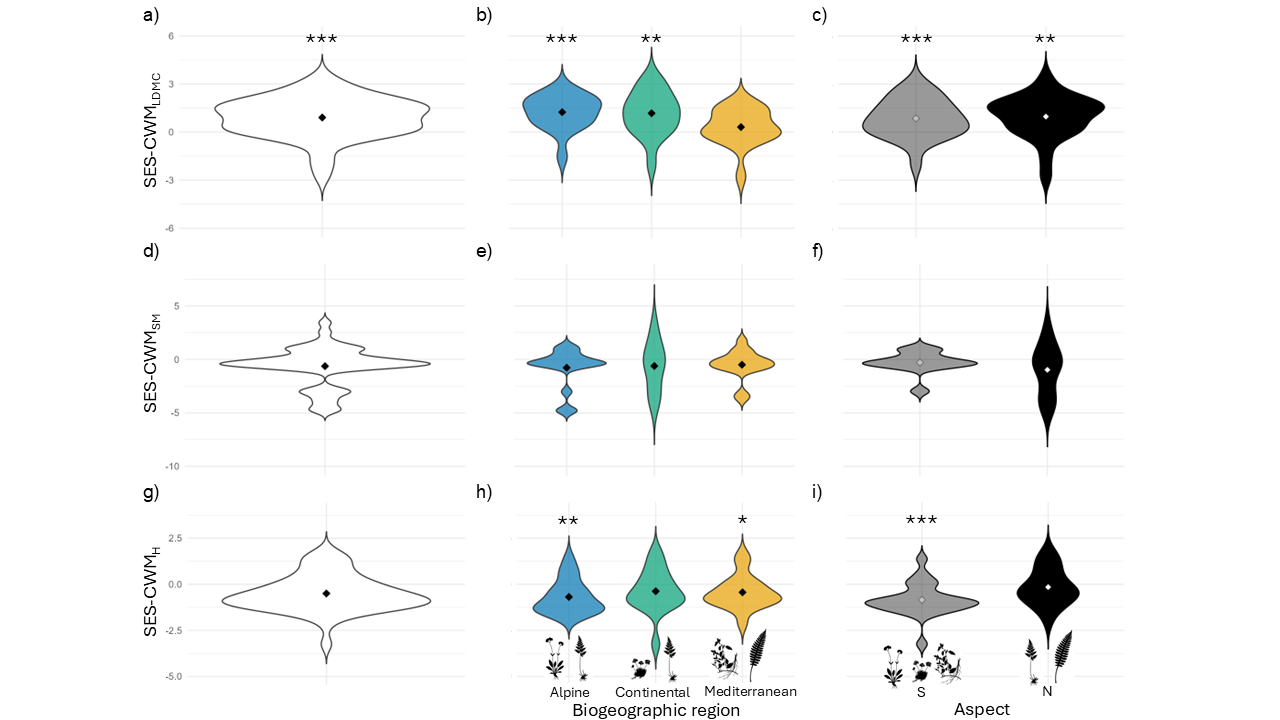
Distribution of standardized effect sizes for community weighted means of three traits proxy of stress tolerance: leaf dry matter content (SES-CWMLDMC, top row), seed mass (SES-CWMSM, middle row) and plant height (SES-CWMH, bottom row). Panels are arranged in a 3 × 3 grid: columns denote the type of comparison and rows correspond to traits. Column 1 (a, d, g) shows the overall distribution of SES-CWM across all plots (n = 48); Column 2 (b, e, h) shows within‑biogeographic‑region variation (alpine, continental, mediterranean); Column 3 (c, f, i) shows the effect of aspect (North vs South). Diamonds indicate sample means. For each panel, the significance of mean values different from zero was assessed with linear models using HC3 robust standard errors. The model intercept (for overall distributions) and the estimated marginal means (for biogeographic regions and aspects) were tested against zero. Significance is shown only when the intercept or the one‑tailed test indicates stress‑tolerance: i.e. SES-CWMLDMC and SES-CWMSM significantly greater than zero (right‑tailed tests), and SES-CWMH significantly less than zero (left‑tailed tests). Significance levels: *** p < 0.001, ** p < 0.01, * p < 0.05.
Export as iCal:
