
Plant size variation between quartz islands and their surroundings in a South African desert ecosystem
2 Institute of Plant Science and Microbiology, University of Hamburg, Hamburg
3 Research Institute on Terrestrial Ecosystems (IRET), National Research Council of Italy (CNR), Porano, Italy
O 4.3 in Changing Climate and Arid Landscapes
30.04.2026, 15:15-15:30, FZA conference room
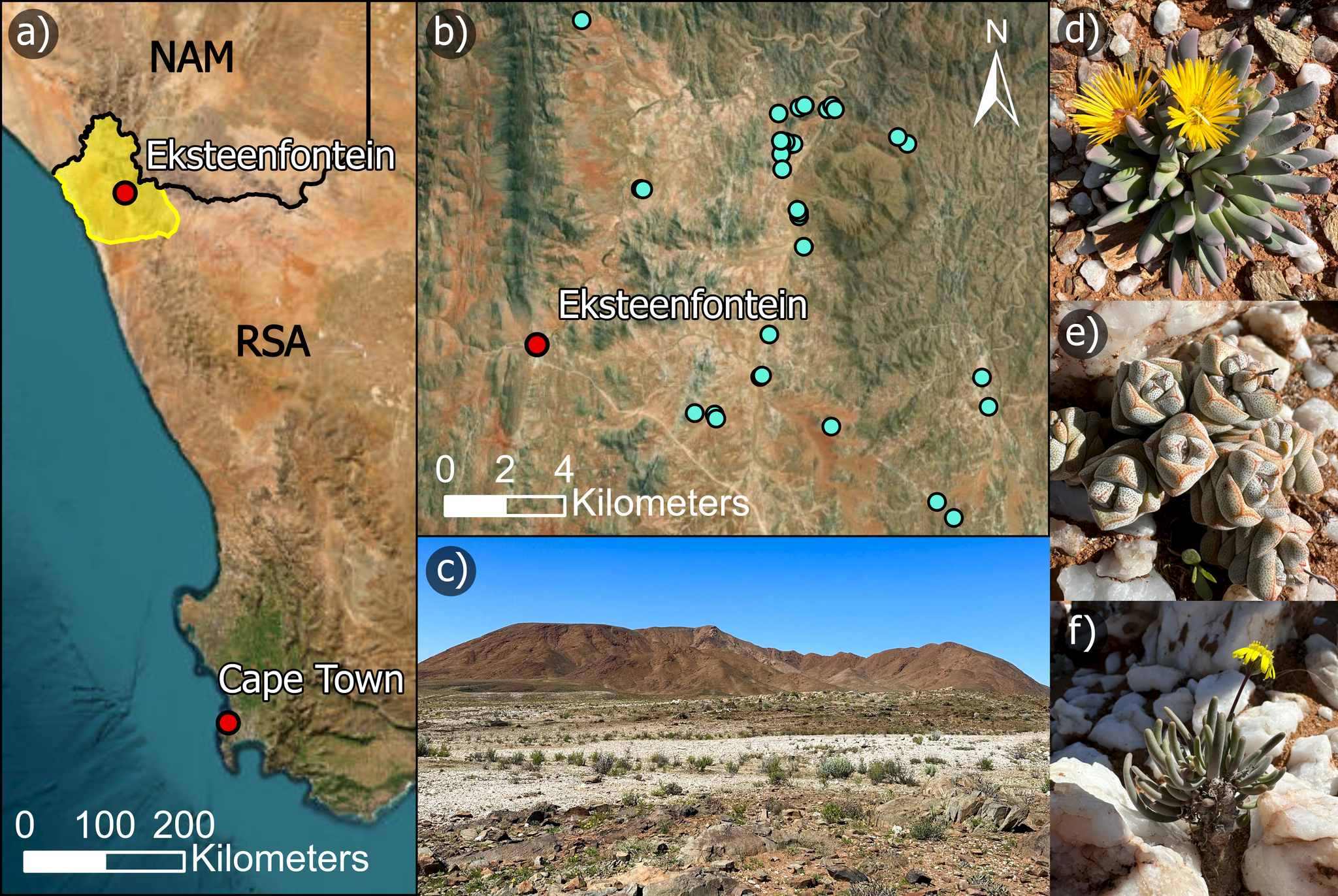
Islands constitute excellent models to disentangle the effect of different biotic and abiotic factors generating plant size variation, so that they have been increasingly studied - a research line that provided fundamental insights into e.g. eco-evolutionary shifts in insular plant size. However, plant size variation in other insular systems (e.g. terrestrial habitat islands) remains unexplored. This is a key gap as these insular systems are expected to have both similarities (e.g. spatio-temporal isolation defined by habitat contrast and permeability against the embedding matrix) as well as differences (e.g. large herbivores’ presence). Here, we address this gap by examining size-related plant traits’ variation of specialist species of terrestrial habitat islands (quartz islands) vs species not restricted to the islands. We collected size-related traits (plant height, leaf length, leaf area, leaf volume) for 67 species belonging to the three most representative families (Aizoaceae, Asteraceae, Crassulaceae) in the Richtersveld desert, South Africa. Species were categorized as quartz specialists (restricted to the islands), generalists (occurring on islands and matrix) and matrix species (found only in the matrix). We ran univariate, bivariate and multivariate analysis to examine whether quartz specialists differ in trait values and coordination compared to generalists and matrix species. Quartz specialists are consistently shorter, yet they are characterized by similar leaf size (and succulence) compared to generalists and matrix species. The variation of whole-plant stature is decoupled from that of leaf traits. The three families differ in their occupancy in the multivariate functional space (niche) whereas habitat specialization groups do not. Our findings suggest evolutionary history and long-term environmental filtering associated with quartz islands’ harsh conditions (high resource scarcity and solar radiation) may operate as main drivers shaping size-related traits, selecting for compact (dwarf) succulent growth forms.
Export as iCal:
