
Tropical Niche Conservatism Hypothesis rejected for plant families along a tropical – alpine gradients
O 6.1 in Tropics
01.05.2026, 11:00-11:15, FZA conference room
Objective: The Tropical Niche Conservatism Hypothesis (TNCH) proposes that most clades originated in warm environments because of evolutionarily conserved ancestral tolerances to subtropical and tropical warm biomes. The prediction that the mean phylogenetic age of plant families in tropical biomes is older than in cooler temperate-alpine biomes was tested. The underlying driving mechanism of this pattern is presumably the global distribution of solar energy. Therefore, one may expect the latitudinal pattern to be repeated along any extensive temperature gradient, for instance, the elevation gradient in tropical and subtropical mountains.
Area: China, the Andes (Peru) and the Himalayas (Nepal).
Methods: Range data on elevation and temperature for all species belonging to 35 monophyletic plant families were compiled across all regions. The plant families represent old, young and intermediate phylogenetic ages. The plant families along the temperature gradient were arranged based on their central tendency, i.e., the maximum number of family members within 0.5 °C intervals. These central tendencies of families along the temperature gradient were established using correspondence analysis and a weighted average temperature (weighted by species counts).
Result: There were no significant correlations between phylogenetic age of families and location along the tropical –alpine temperature gradient. The result was confirmed across all regions, and we therefore rejected the TNCH that predicts strong relationships between the phylogenetic age of families and their central tendency along extensive temperature gradients.
Conclusion: I found no support for the TNCH hypothesis that older families, on average, preferred warmer subtropical locations and that younger families were more common in alpine and subarctic biomes. Mountains play a special role in plant evolution due to isolation and the proximity of temperature extremes, which may have influenced the age-family distribution.
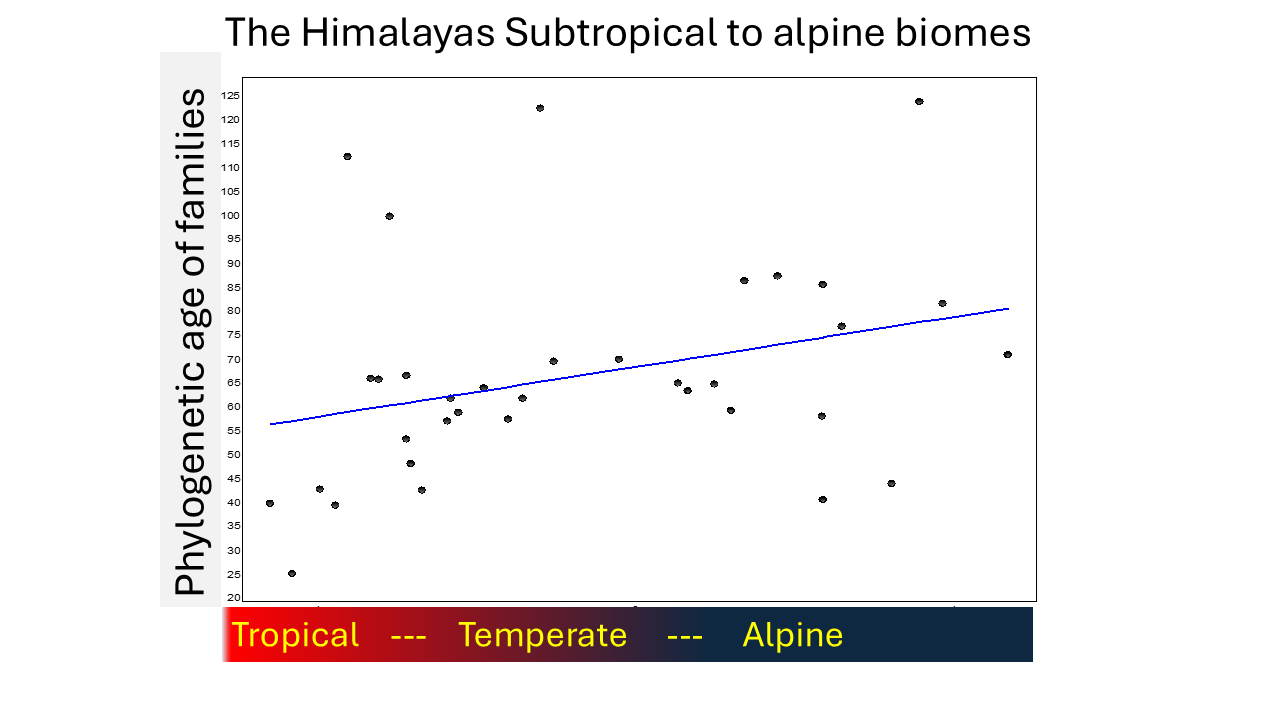
Horizontal axis depicts the central tendency of families from tropical to alpine environment in the Himalayas, and the vertical axis shows Phylogenetic age of families. Spearman rank-correlation Rho= 0.399 p>0.07, Not significant (n=35).
Export as iCal:
