
Diverging responses of taxonomic, functional, and phylogenetic plant diversity to biogeographic parameters in arid habitat islands of southern Africa
2 Institute of Plant Science and Microbiology, University of Hamburg, Hamburg, Germany
3 Institute for Globally Distributed Open Research and Education (IGDORE), Hamburg, Germany
P.2 in Postersession
Habitat islands conceptually bridge true islands and habitat patches, adding new perspectives to island biogeographic principles that shape community assembly processes. Despite growing interest, empirical studies are scarce and the drivers of biodiversity in these systems, such as different aspects of island shape, isolation and habitat diversity, remain unclear. Our aim was to assess how biogeographic parameters influence taxonomic, functional, and phylogenetic plant diversity on habitat islands using quartz islands in South Africa as our model system. We conducted floristic surveys on 20 quartz islands in the harsh and arid summer-rainfall region around Pofadder (Nama–Karoo, South Africa) to quantify species richness, functional dispersion, and phylogenetic mean pairwise distance. Via remote sensing, we derived island metrics and evaluated their effects on the diversity metrics, using multivariate regression analysis. We fitted negative binomial generalized linear models for species richness and linear models for functional and phylogenetic diversity. Island area emerged as the strongest predictor of species richness, consistent with island biogeographic theory. Connectivity was a significant predictor for functional dispersion and explained most of the variation. The mean pairwise distance was significantly influenced solely by the area of the nearest neighbour island, although its explanatory power was only moderate. Our findings highlight that different facets of diversity respond distinctively to biogeographic parameters. Integrating taxonomic, functional, and phylogenetic perspectives is therefore essential for a comprehensive understanding of biodiversity patterns on habitat islands and for providing valuable insights for conservation.
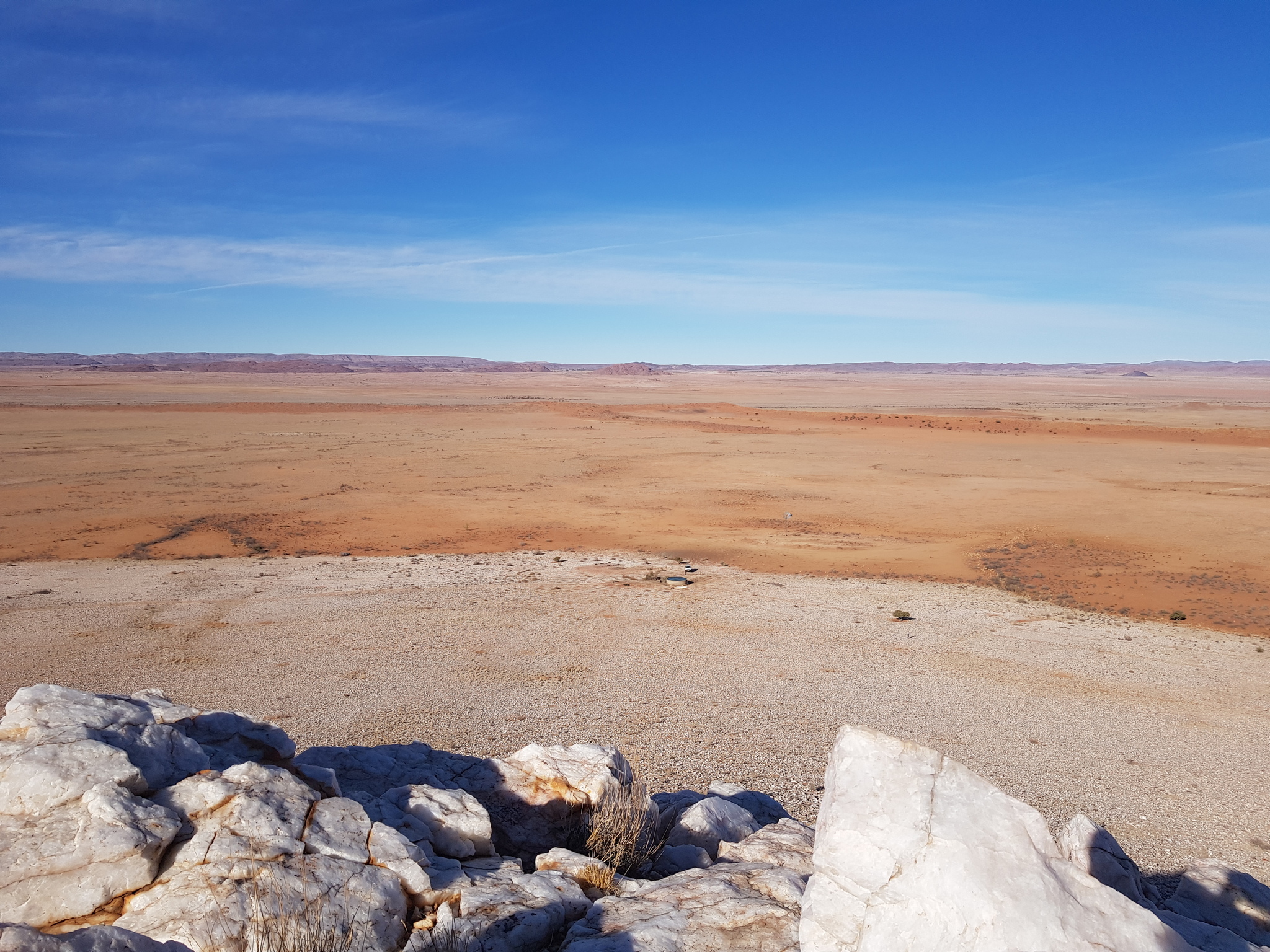
Quartz island in the Pofadder region. © Alexander M. Bürger