


BayCEER Workshop 2026
08. October 2026
How are natural recruits of forest trees distributed with regard to their parents?
1.3 in Morning Session
08.10.2026, 11:45-12:00, H 36
In Europe, adult trees are dying at faster rates than they did a few decades ago. The focus of forestry therefore shifts to sustainability, which is achieved in Germany (mainly) with natural regeneration. However, we do not comprehensively know how forest tree species naturally regenerate, especially in the context of how the current adult stand of a forest looks like. We collect data on adult trees, recruits, and seed production in eight forest nature reserves in eastern Bavaria on an altitudinal gradient ranging from ca. 340 m (Inn river) to 1450 m a.s.l. (Mt. Großer Arber). By collecting these over years at the same sites with exact coordinates, we can statistically analyze the spatial association of each demographic stage (incl. adults) within species. We use a joint distribution model, the latent variable model GLLVM, to uncover that the environment can mostly explain why forest tree species, regardless of demographic stage, tend to not co-occur. After accounting for the environment, a pattern of weak association between adults and recruits of the same species becomes apparent. This can contextualize our expectation of how forests naturally regenerate based on their current adult structure.
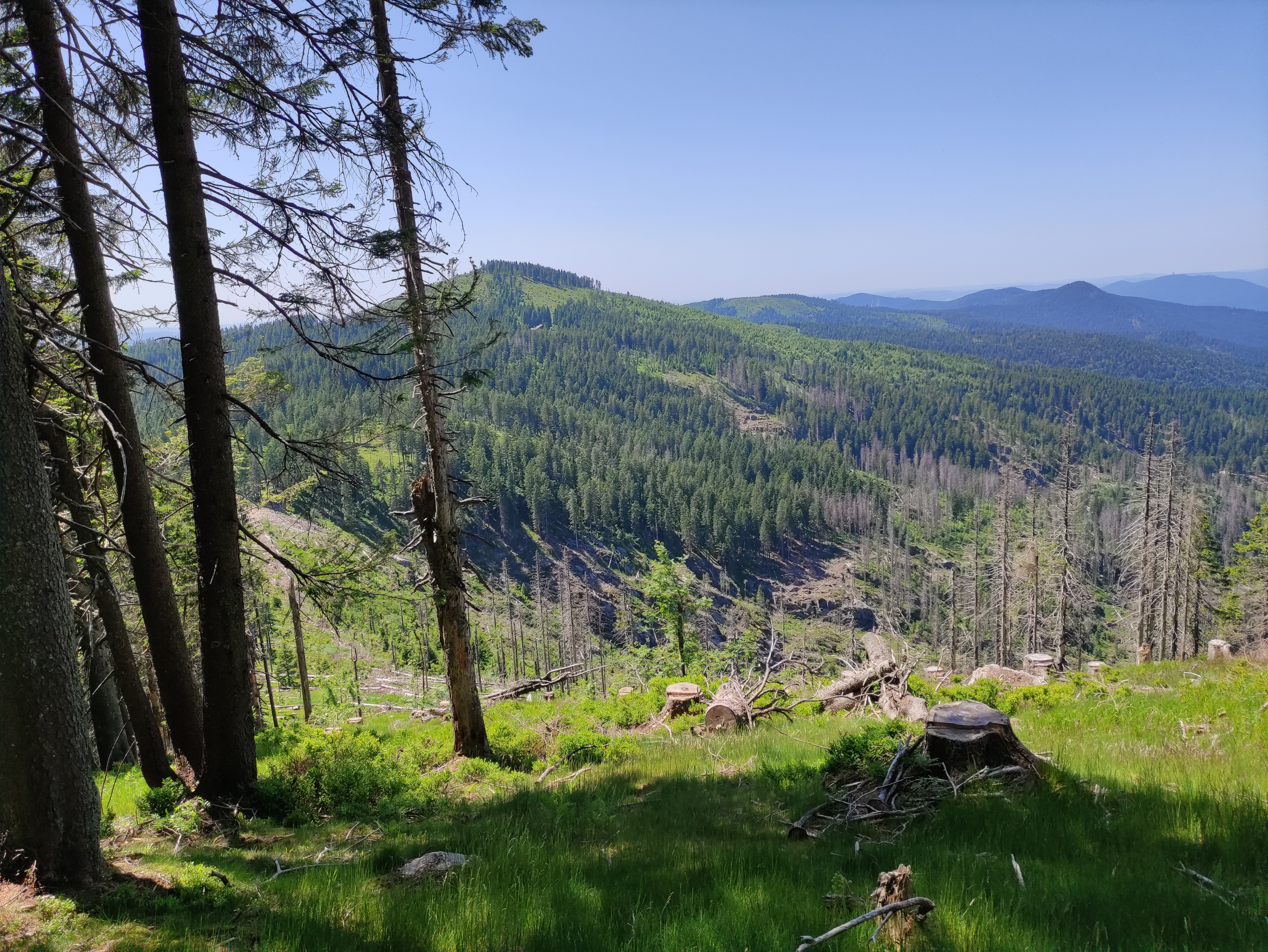
High recent adult tree mortality challenges us to understand natural forest regeneration urgently. Shown is the west side of the Mt. Großer Arber with the Mt. Kleiner Arber in the background.
Keywords: joint distribution model, forest regeneration, natural regeneration, spatial ecology, forest ecology, temperate forests
Export as iCal:
