
Structure 2026/27
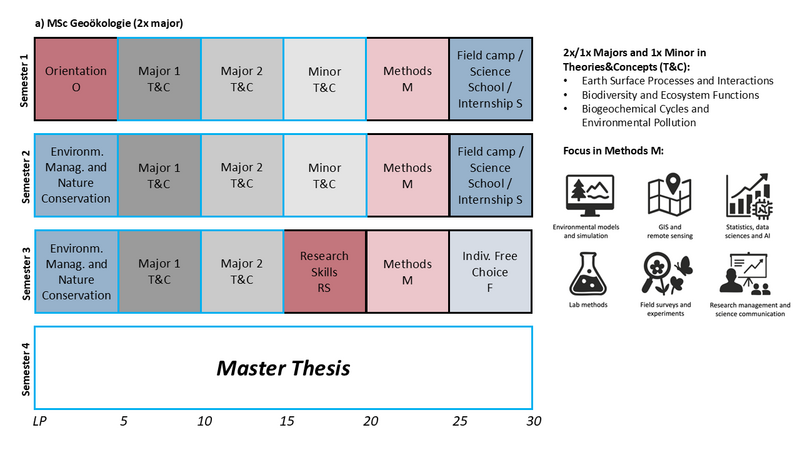
The general structure of the program (120 ECTS) brings together natural sciences (70 %) and social sciences (30%) and is since the winter term 2026/27 renewed. Please note that the other categories within the folder "Study" will be updated step by step.
 The language of instruction is English.
The obtained degree is a Master of Science. Based on additional research activity, a PhD degree can be obtained.
The courses in the graduate program require a high level of performance. Students are selected via a standardized aptitude assessment procedure (see regulations for more details) that meets the highest international criteria. Bachelor degrees related to all fields of environmental science will provide for acceptance to the program. Finally, a select number of students will be accepted who may profit from excellent infrastructure and direct one-on-one communication with their supervisors.
Please find detailed general information on the Global Change Ecology MSc study program in the overview study guide available for download here.
Modules & Courses
Teaching is organised in modules, typically worth 5 ECTS each. Students are expected to
complete approximately 30 ECTS per semester. The curriculum is built around three central
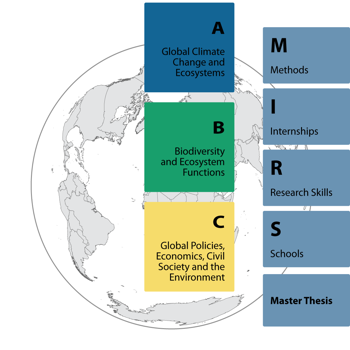
Module Areas “Theories & Concepts”, which run in parallel throughout the programme:
• Global Climate Change and Ecosystems
• Biodiversity and Ecosystem Functions
• Global Policies, Economies, Civil Society and the Environment
These Module Areas form the academic backbone of the programme and ensure continuous
engagement with the core dimensions of global change.
A: Global Climate Change and Ecosystems
The Global Climate Change and Ecosystems specialisation focuses on understanding how rising global temperatures affect climate systems, ecosystems, and human societies. Climate change alters rainfall patterns, evapotranspiration, and environmental conditions across local to global scales, influencing ecosystems, soils, agriculture, water systems, and urban environments.
The program aims to build knowledge of climate processes and ecosystem functions while highlighting the interconnected nature of environmental and societal systems.
Students learn to analyse climate impacts using field data, modelling, and interdisciplinary approaches.
Courses cover topics such as climate change, ecological climatology, extreme events, land-use change, agroecosystems, soils, and hydrological systems, supported by methodological training in statistics, modelling, and climate data analysis.
Please find detailed information on this module in the study guide Global Climate Change and Ecosystems available for download here
B: Biodiversity and Ecosystem Functions
The Biodiversity and Ecosystem Functions specialisation explores how biodiversity supports
the stability and resilience of Earth’s ecosystems. It examines patterns, drivers, and
consequences of biological diversity and its role in key ecosystem processes such as productivity, nutrient cycling, and climate regulation. The program emphasises interactions between biodiversity and abiotic factors like soil, water, and climate, highlighting feedbacks where biodiversity actively shapes environmental conditions.
Students learn about the mechanisms that generate and maintain biodiversity, the threats ecosystems face, and the importance of ecosystem services for human well-being.
The specialisation combines theoretical courses with fieldwork, data analysis, modelling, and science schools to develop skills in biodiversity research, ecosystem assessment, and sustainable ecosystem management.
Please find detailed information on this module in the study guide Biodiversity and Ecosystem Functions available for download here
C: Global Policies, Economies, Civil Society and the Environment
The Global Policies, Economies, Civil Society and the Environment examines how political, economic, and societal systems respond to global environmental challenges such as climate change, biodiversity loss, and declining ecosystem services. It focuses on understanding the societal processes that both create environmental problems and contribute to their mitigation.
The program introduces economic, political, geographical, and socio-ecological theories while emphasising interdisciplinary perspectives on complex socio-ecological systems. Students develop skills to critically analyse global economic activities, environmental policies, and governance approaches addressing climate, land use, and biodiversity issues.
Courses also explore connections between environmental change and human, animal, and ecosystem health,supported by methods in policy analysis, social science research, and sustainability assessment.
Please find detailed information on this module in the study guide for Global Policies, Economies, Civil Society and the Environment, available for download here
M: Methods courses
Method-oriented courses comprise 15 ECTS. They are offered to deepen students' knowledge of methodological approaches across various fields, thereby strengthening students' personal interests. The following method groups are offered:
- Statistics, Data Science, and Artificial Intelligence
- GIS and Remote Sensing
- Environmental Modelling and Simulation
- Field Surveys and Experiments
- Analysis of Environmental Solutions in Policies, Economies and the Civil Society
- Research Management and Science Communication
Introductory courses are designed to fill knowledge gaps, support individual interests,
and equip students with essential skills for advanced modules and research. Those methods will also typically be applied in the master's thesis.
Method modules are assessed but not graded, allowing students to focus on skill acquisition.
Please find more details in the study guide for methods, available for download here
I & S: Internships and Science Schools
The study of global change ecology extends beyond course modules, and offers the opportunity to strengthen practical skills and professional orientation through Internships and Science Schools.
These experiences typically take place during lecturefree periods.
Internships offer the opportunity to gain practical experience. They allow students to engage in four main areas, including research institutions (not universities), governmental agencies, NGOs, or private-sector organisations.
Science schools aim at integrating students into current developments in the rapidly changing scientific field of global change research. Intensive external and internal courses allow students to make direct contact with not only other lecturers and real-world practitioners but also peers from other study programs, universities and countries.
R: Research Skills
A mandatory, ungraded Research Skills (R) module prepares students for the master thesis.
This module ensures that students are equipped to conduct independent scientific work and
engage with complex interdisciplinary questions.
It covers
• Scientific writing and research data management
• Development of a research plan
• Presentation of the master thesis.
M: Master's Thesis
The fourth semester is fully dedicated to the Master’s Thesis (30 ECTS). The thesis must be anchored in one of the three Module Areas but should demonstrate a multidisciplinary perspective. Students typically conduct their thesis within ongoing research projects at affiliated chairs.
Figure on the overview of the 4 semesters: